
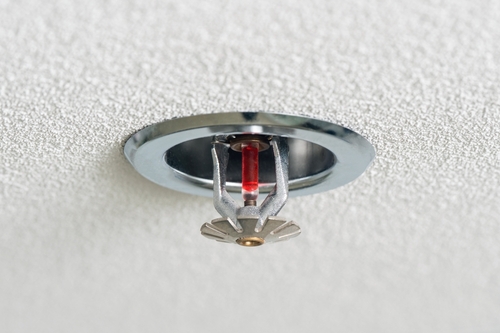
A sprinkler going off in a server room can cause more damage than the fire it was meant to suppress. Water and electronics do not mix, and for San Diego businesses that rely on data centers, server rooms, telecom hubs, or any facility housing sensitive electronic equipment, traditional water-based suppression is the wrong answer.
Clean agent fire suppression systems solve this problem. They extinguish fires quickly, leave no residue, and do not damage the equipment they are protecting. For the growing number of data-dependent businesses operating in San Diego County, understanding these systems is essential.
How Clean Agent Suppression Works
Clean agent systems use chemical or inert gas agents stored under pressure in cylinders. When the detection system identifies a fire – typically through very early smoke detection (VESDA) or standard smoke detectors — the agent is discharged into the protected space within seconds.
There are two categories of clean agents: chemical agents and inert gas agents. Understanding the difference matters because the landscape has shifted significantly in recent years.
Chemical agents like FM-200 (HFC-227ea) were the industry standard for decades. However, FM-200 has been phased out due to its high global warming potential – following the same trajectory as Halon 1301 before it. The current replacement is Novec 1230 (FK-5-1-12), which offers the same rapid fire suppression performance with a dramatically lower environmental impact. For any new installation in San Diego, Novec 1230 is the chemical agent being specified.
Inert gas systems are the other major category and have been a proven alternative to chemical suppression for decades. These systems use naturally occurring gases to reduce oxygen concentration in the protected space to a level that cannot sustain combustion while remaining safe for human occupancy. Lin Tec Fire Solutions installs and services several inert gas options including IG-100 (nitrogen), IG-55 (nitrogen/argon blend), IG-01 (argon), and IG-541 – previously marketed as Inergen – which uses a blend of nitrogen, argon, and a small percentage of CO2.
Inert gas systems have zero global warming potential and zero ozone depletion potential, making them an excellent long-term choice for facilities concerned about environmental regulations and future-proofing their fire protection investment.
Neither chemical nor inert gas agents leave behind residue, moisture, or particulate – which means your servers, switches, and storage hardware remain undamaged and operational after a discharge event. That is the entire point.
Why San Diego Data Centers Need Specialized Suppression
San Diego has a significant concentration of data center and colocation facilities serving the defense, telecom, biotech, and tech industries. The climate, connectivity infrastructure, and proximity to military operations make it a prime location for mission-critical facilities.
These environments have fire risks that general commercial buildings do not – concentrated electrical loads, battery backup systems, cable trays, and high air circulation from HVAC systems that can spread smoke quickly. A clean agent suppression system designed specifically for these hazards addresses the risk without creating secondary damage.
Choosing the Right Agent for Your Facility
The right clean agent depends on your specific environment, budget, and priorities.
Novec 1230 is ideal when you need the fastest possible suppression in a compact space. It works well for smaller server rooms and telecom closets where cylinder storage space is limited and rapid discharge is critical.
Inert gas systems (IG-100, IG-55, IG-01, IG-541) are better suited for larger protected volumes and facilities where long-term environmental compliance is a priority. Because the agents are naturally occurring gases, there is no risk of future regulatory phase-outs – a real concern for facilities with a 20-plus year operational horizon.
A qualified fire protection design and consulting team can evaluate your space and recommend the right agent based on room size, hazard type, ventilation characteristics, and your operational requirements.
Design and Code Considerations
Clean agent systems in San Diego must be designed in compliance with NFPA 2001 (Standard on Clean Agent Fire Extinguishing Systems) for chemical agents or NFPA 2001 and ISO 14520 for inert gas systems, along with the California Fire Code. The system design accounts for room volume, ceiling height, ventilation rates, and the type of hazard being protected.
Proper room integrity is critical. Clean agent systems work by achieving a specific concentration within the protected space, and that concentration must be maintained long enough to suppress the fire completely. If the room has unsealed penetrations, gaps under doors, or significant HVAC leakage, the agent dissipates too quickly and the system may not perform as designed.
A room integrity test (door fan test) should be conducted as part of the design process to verify that your space can hold the agent at the required concentration.
Integration with Fire Alarm Systems
Clean agent suppression does not operate in isolation. The discharge sequence is triggered by the fire alarm system, which typically requires a cross-zone or double-knock detection confirmation to prevent accidental discharge.
Here is how the sequence usually works: the first detector activates and triggers a pre-alarm. A second detector confirms the fire condition. The system initiates an audible countdown, giving personnel time to evacuate. The agent then discharges.
This integration between alarm detection and suppression discharge must be designed, installed, and tested as a unified system to function correctly. Having a single contractor manage both the fire alarm and suppression components ensures they are programmed and commissioned to work together.
Next Steps for San Diego Facility Managers
If you manage a data center, server room, or any facility with high-value electronic equipment in San Diego, and your current fire protection is limited to sprinklers or you have an older FM-200 or Halon system that needs replacing, a professional evaluation is the starting point. A licensed fire protection contractor can assess your space, recommend the right agent – whether Novec 1230 or an inert gas system like IG-541 – and design a solution that meets both NFPA 2001 and local San Diego code requirements.





Commercial Property ManagerSan Diego, CA